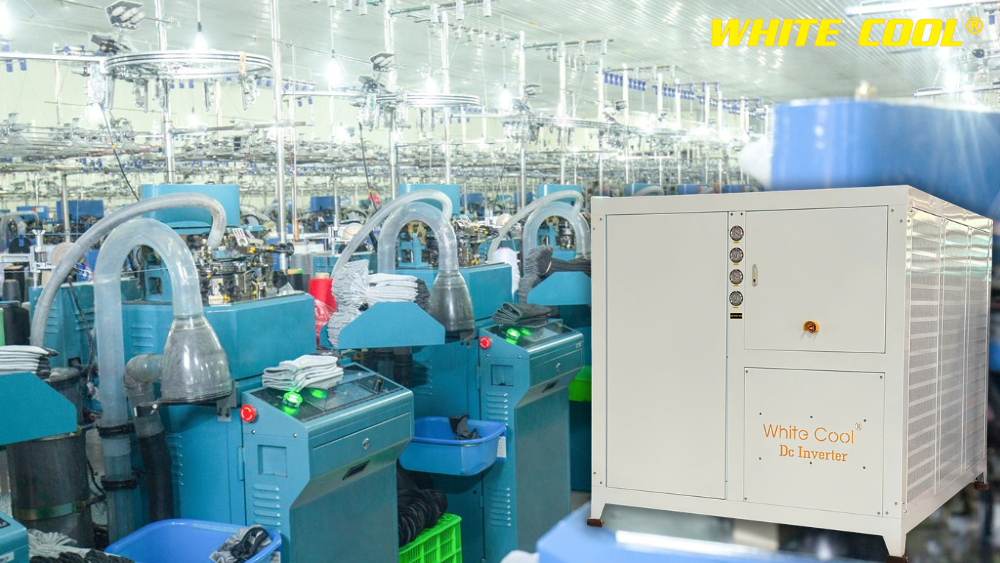


WHAT IS COOLING LOAD?
Cooling load is the amount of heat that a cooling system needs to remove from a space, piece of equipment, or production process within a certain period of time in order to maintain the required temperature conditions.
Simply put, if a factory needs to cool water for a production line, the Chiller system must be capable of removing heat from the water and bringing it down to the required temperature. The amount of heat that needs to be removed is the basis for determining the cooling load.
In industrial Chiller systems, cooling capacity is commonly expressed in kW of cooling capacity, RT (Ton of Refrigeration), or HP, depending on industry practices and the equipment supplier. However, when selecting equipment, businesses should not rely solely on the nominal capacity rating. The actual operating conditions of the entire system must also be taken into consideration.
WHY IS IT IMPORTANT TO DETERMINE THE COOLING LOAD BEFORE SELECTING A CHILLER?
Selecting a Chiller is not simply a matter of choosing the largest possible capacity. The Chiller capacity should correspond to the actual cooling requirements of the system.
If the Chiller capacity is lower than the required cooling load, the equipment may have to operate continuously at high load while still being unable to achieve the required temperature. This can affect the production process and reduce system stability.
On the other hand, selecting an oversized Chiller does not necessarily result in better efficiency. Initial investment costs may increase, while the equipment may frequently operate at low load. If the control configuration and capacity modulation are not appropriate, energy efficiency may not meet expectations.
Therefore, accurately determining the cooling load is an important step in selecting a Chiller that is suitable in terms of capacity, efficiency, and long-term operating costs.
FACTORS THAT AFFECT COOLING LOAD
The cooling load of a system depends on various factors, and not every system uses exactly the same calculation method.
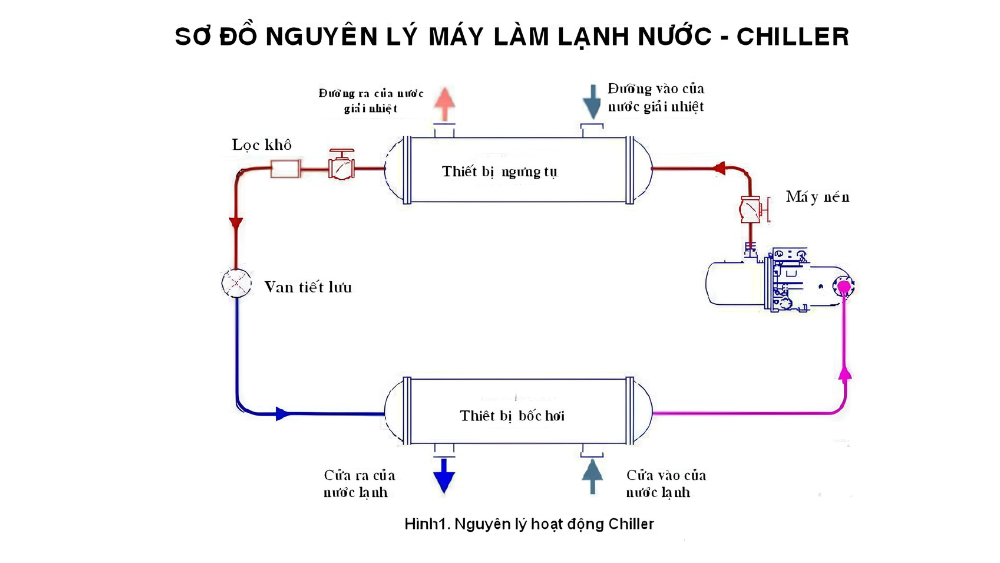
For a Chiller serving a production process, the first parameters to determine are the water inlet temperature, water outlet temperature, and water flow rate. These are important parameters for determining the amount of heat that the Chiller needs to remove from the water.
The cooling load can be understood through the following relationship:
Q = m × Cp × ΔT
Where Q is the amount of heat to be removed, m is the mass flow rate of water, Cp is the specific heat capacity of water, and ΔT is the temperature difference between the inlet and outlet water.
In practice, in addition to chilled-water parameters, engineers also need to consider the characteristics of the equipment or production process. For example, an injection molding line, HVAC system, production mold, cold storage facility, or industrial process may have completely different cooling requirements even though they all use Chillers.
For some systems, the cooling load is also affected by heat generated by the surrounding environment, electrical equipment, motors, products, piping, pumps, and other heat sources. Therefore, cooling load calculations should be based on actual operating conditions rather than simply relying on an estimated figure.
HOW TO DETERMINE THE COOLING LOAD FOR A CHILLER SYSTEM
Determine the purpose of the Chiller
The first step is to determine whether the Chiller is being used to cool a production process, equipment, working area, or HVAC system.
Each application has different requirements for chilled-water temperature, flow rate, operating time, and load variation. These factors provide the basis for engineers to determine the appropriate cooling load calculation method.
Determine the required chilled-water temperature
The business needs to determine the water supply temperature delivered to the equipment and the return-water temperature to the Chiller. The difference between these two temperatures directly affects the required cooling capacity.
For example, if a system needs to cool water from 15°C to 10°C, the required cooling load will be different from a system cooling water from 25°C to 15°C, even when the water flow rate is the same.
Determine the water flow rate
Water flow rate is another important parameter. The higher the flow rate, the greater the amount of heat that may need to be removed within the same period of time.
Therefore, when consulting on a Chiller system, it is important not only to provide the required water temperature but also to determine the actual water flow rate of the system.
Determine the heat sources that need to be removed
This is an important step in making the calculation more representative of actual operating conditions.
Engineers need to consider the amount of heat generated by machinery, products, molds, motors, electrical equipment, and production processes. If these heat sources are overlooked, the calculated cooling load may be lower than the actual requirement.
For HVAC systems, additional factors such as the area of the space, number of occupants, heat-generating equipment, environmental conditions, and heat transfer through the building structure should also be considered.
Determine the actual operating conditions
A production system may not operate at the same load throughout the day. Cooling demand can vary depending on production shifts, the number of machines in operation, production volume, or environmental conditions.
Therefore, Chiller selection should consider the maximum cooling load, average cooling load, and load variation rather than relying on a single load level.
FROM COOLING LOAD TO CHILLER CAPACITY SELECTION
After determining the cooling load, businesses should not simply select a Chiller by matching the calculated cooling load to a corresponding equipment capacity.
Other factors should also be considered, including ambient temperature, chilled-water inlet and outlet temperatures, Chiller type, heat rejection method, installation conditions, system expansion requirements, and especially the load characteristics of the production process.
In some cases, using a single large-capacity Chiller may not be the most optimal solution. The business may benefit from multiple Chillers operating in parallel or from a configuration with capacity modulation to better respond to changing loads.
This is also why two businesses with the same cooling load may require two different Chiller configurations.
SHOULD A SAFETY MARGIN BE ADDED WHEN SELECTING A CHILLER?
In actual system design, engineers may consider an appropriate safety margin so that the system can accommodate increased loads or changes in operating conditions.
However, adding a safety margin does not mean choosing a Chiller that is as large as possible.
The appropriate margin should be determined based on the characteristics of the system, potential future load growth, the stability of the production process, and the capacity-control strategy. Selecting excessive capacity may increase investment costs without providing corresponding value during operation.
HOW DOES WHITE COOL APPROACH COOLING LOAD CALCULATIONS?
For an industrial Chiller system, White Cool does not simply focus on selecting a model based on a calculated cooling capacity.
The solution should be evaluated based on the actual needs of the business, operating conditions, water temperature, flow rate, load characteristics, and production process requirements. These factors provide the basis for selecting an appropriate Chiller capacity and configuration.
For projects with variable loads, the control strategy and capacity modulation capability should also be considered so that the system can operate appropriately at different load levels rather than being optimized for only one fixed operating condition.
CONCLUSION
Cooling load is the foundation for determining Chiller capacity and configuration. Accurately calculating the cooling load helps businesses avoid insufficient capacity, minimize unnecessary oversizing, and establish a cooling system that is appropriate for actual operating requirements.
More importantly, Chiller selection should not stop at the question, “How many HP does the Chiller need?” Instead, it should begin with the question, “How much cooling load does the system actually require, and what are its operating conditions?”
If your business is preparing to invest in a Chiller system but has not yet determined the cooling load or is uncertain about the appropriate capacity and configuration, White Cool can work with your business to analyze your cooling requirements, operating conditions, and propose a Chiller solution tailored to your specific application.
Contact White Cool for consultation on Chiller solutions based on your business’s actual cooling requirements.